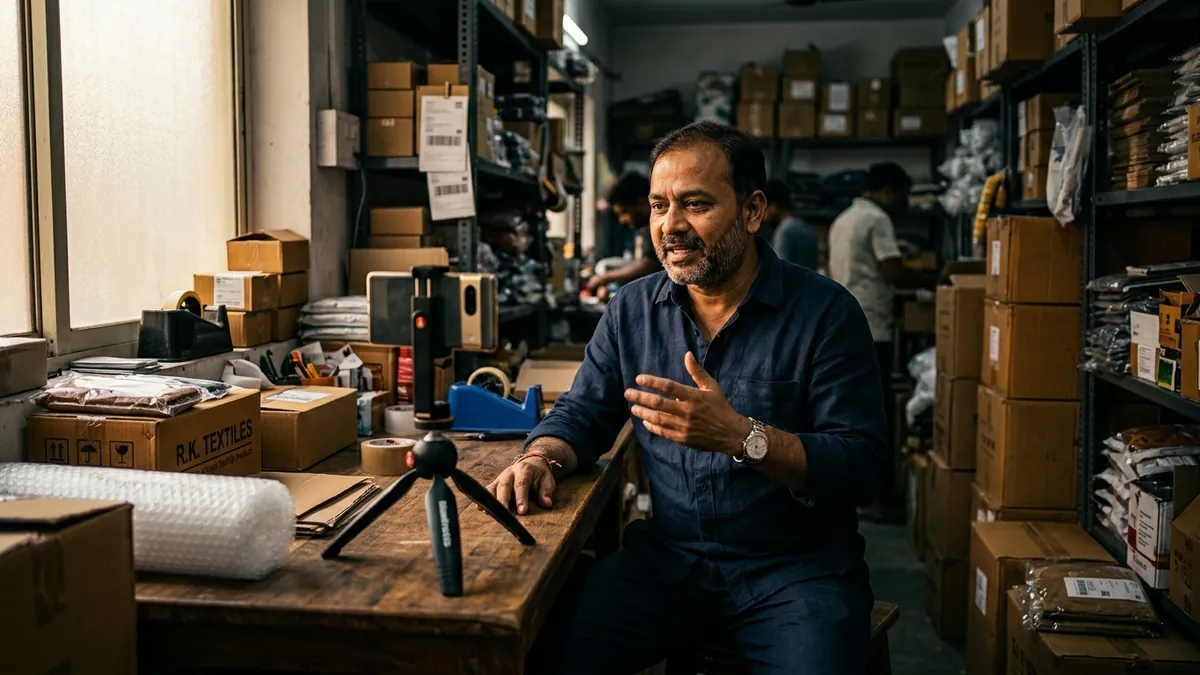
Why Founder-Led Content Works Better Than Brand Posts

Most business owners I meet have two Instagram or LinkedIn accounts. One is their company page — well-designed, regular posts, decent followers. The other is their personal profile — almost empty, last post from 2021. They spend time and money on the brand page. And then wonder why it brings in zero business.
Here is what I have seen again and again. A founder posts one honest photo from their factory floor with a two-line caption about a production problem they solved. Within 48 hours, three old contacts message them. One becomes a client. Meanwhile, the brand page's Diwali graphic got eleven likes — mostly from employees.
People buy from people. That sounds obvious, but most Indian MSME owners still behave like only large companies with TV ads are allowed to put a face to their brand. That thinking is costing them. When a buyer or a business partner is evaluating two similar vendors, the one whose founder they feel they know a little — whose thinking they have seen, whose struggles they understand — that founder wins the deal more often than not.
Founder-led content does not mean you need to become a content creator or post every day. It means showing up occasionally, in your own voice, about things you genuinely know. A Bengaluru textile manufacturer I worked with started posting once a week on LinkedIn — just short observations about fabric procurement, quality rejections, conversations with buyers. Within four months, he was getting inbound enquiries from brands in Hyderabad and Pune who had never heard of his company before. No ads. No agency. Just him talking about his work honestly. If you want to understand what is holding your current brand communication back, a brand analysis is a good place to start.
There are three things that make founder content actually work. First, specificity. Not 'we deliver quality products' but 'we rejected a batch last week because the GSM was 4 points below spec and the client would never have noticed but we would have.' Specific beats generic every time. Second, consistency over volume. Posting twice a month for a year beats posting daily for six weeks and then disappearing. Third, a point of view. Share what you think, not just what happened. Opinions make people remember you.
LinkedIn works better for B2B founders — manufacturers, consultants, service businesses, export houses. Instagram works better if your buyers are consumers or if your product or process is visual. Some founders I know do both, but if you are starting out, pick one platform and get comfortable there first. Do not spread yourself thin trying to be everywhere. I discuss this channel choice in detail during my one-to-one consultation because the right platform depends entirely on who your actual buyer is and where they spend time.
One practical concern founders raise: 'What if I run out of things to say?' You will not, if you stop thinking of it as content creation and start thinking of it as documenting your work. This week, what problem did you solve for a client? What did a supplier conversation teach you? What decision did you make and why? What would you do differently if you started this business today? These are not empty questions — they are real business knowledge that your buyers and future partners genuinely want to hear from you.
Another concern: 'I am not a good writer.' You do not need to be. Write like you speak. Short sentences. No jargon. If your English feels stiff, write in Kannada, Hindi or Tamil — regional language posts on LinkedIn are performing surprisingly well with local business communities. Record a voice note first if that helps, then convert it roughly to text. The goal is to sound like you, not like a press release.
If your business is at a stage where you are trying to grow systematically — more enquiries, better-quality clients, higher trust before the sales call — founder-led content is one of the highest-ROI activities you can do right now. It costs almost nothing except time. And unlike ads, the credibility it builds compounds over months. You can also bring this conversation into a structured growth discussion at the 2-day business growth workshop, where we work through your positioning, communication and sales together with other founders. Start with one post this week. Something real from your business this month. See what happens.
Want to understand where your business growth is stuck?
Book a Business Growth Diagnostic with Abhijit JK — an honest, focused 60-minute one-to-one session with Abhijit JK on your brand, website and growth.
Book a Business Growth Diagnostic