Why Your Website Copy Talks About You, Not the Buyer
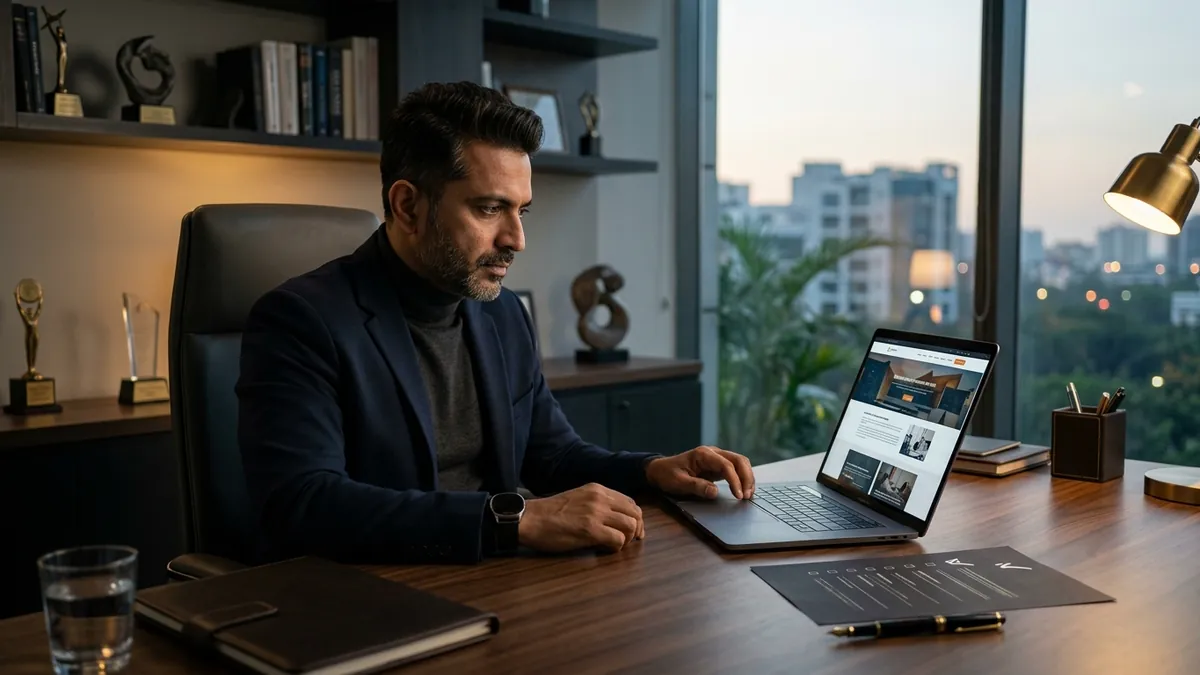
Open your website homepage right now. Read the first three lines. Count how many times it says 'We', 'Our', or your company name. If you hit three or more within the first paragraph, you already know why visitors are leaving without enquiring. Most business owners I meet have spent good money on a website that is essentially a digital brochure about themselves. The buyer does not care — at least not yet.
Here is how a buyer actually behaves. They land on your page with one question in their head: 'Can this person solve my problem?' They are not reading your story. They are scanning for signals. If your homepage opens with your founding year, your team size, or your list of services arranged like a menu — you have lost them in the first eight seconds. I have audited websites for manufacturers, consultants, interior designers and retail brands across Karnataka and Maharashtra. The pattern is always the same. The business is talking. The buyer is not listening.
There is a simple test I use called the 'So What' test. Take any sentence on your homepage and ask: so what? 'We have 200+ clients across India.' So what? 'We use the latest technology.' So what? 'We are ISO certified.' So what? None of these answer the buyer's real question. They are credentials, not promises. Credentials earn trust after the buyer is already interested. They do not create interest by themselves.
The fix is not complicated, but it does require you to shift your thinking. Stop writing from your side of the table. Start writing from the buyer's side. Instead of 'We offer end-to-end packaging solutions for manufacturers,' try 'If you are losing sales because your packaging looks cheap, we can fix that in 30 days.' The second version speaks to a real pain. The buyer immediately sees themselves in it. That is what makes someone scroll, read more, and eventually hit your contact button. If you want to go deeper on this with your own website, a one-to-one consultation can help you rewrite the critical sections that are costing you enquiries.
Another mistake I see constantly is burying the offer. A founder will spend three paragraphs explaining what the company does, two paragraphs on their history, and then somewhere near the bottom, almost as an afterthought, mention what the buyer should do next. The call to action is weak, late, and vague. 'Get in touch with us today' sitting under a wall of text does nothing. Your call to action needs to appear early, be specific, and tell the buyer exactly what happens when they click it. 'Book a free 30-minute packaging review' is ten times better than 'Contact Us'.
One thing I notice with service businesses especially — coaches, consultants, agencies, training companies — is that they confuse describing services with communicating value. There is a real difference. A service is what you do. Value is what changes for the buyer after you do it. 'We conduct sales training workshops' is a service description. 'Your sales team closes 30% more deals without discounting' is a value statement. Buyers buy outcomes. They hire processes only after they trust the outcome is real. I cover this in more detail during my business growth workshops for founders, because it applies not just to websites but to every sales conversation you have.
The about page deserves its own mention. Most about pages are either a timeline of company milestones or a personal biography of the founder. Neither of these is what a buyer visits the about page for. They go there to answer one question: 'Can I trust this person with my problem?' The best about pages I have helped build start with the buyer's world, transition to how and why the founder got into this work, and end with a clear statement of who they specifically help. It builds trust without sounding like a resume. If you want to understand how I approach this in my own work, you can read more on the about Abhijit page.
Here is a practical action you can take this week. Pick your five most important pages — homepage, about, services, contact, and your top-performing landing page. On each page, highlight every sentence that starts with 'We', 'Our', or your brand name. Then rewrite at least half of those sentences so they start with 'You', 'Your', or name the buyer's specific situation. It is not about removing yourself from the website entirely. It is about leading with the buyer first and letting your credentials follow naturally. This small edit alone has helped some of my clients double their enquiry rate without changing design, traffic or budget.
Your website is not a trophy for your achievements. It is a salesperson working 24 hours a day. The best salespeople do not talk about themselves the moment someone walks in. They ask questions. They listen. They reflect the buyer's problem back to them and then offer a solution. Your website copy should do the same. The businesses I have seen grow fastest are the ones that figured this out early — that communication is not about how much you say, but how clearly the buyer sees themselves in what you say. If you are ready to fix yours, reach out through the contact page and we can look at it together.
Want to understand where your business growth is stuck?
Book a Business Growth Diagnostic with Abhijit JK — an honest, focused 60-minute one-to-one session with Abhijit JK on your brand, website and growth.
Book a Business Growth Diagnostic

