Why Your Customer Journey Stops at the First Sale
Most business owners I meet are obsessed with getting the next new customer. They spend on ads, attend networking events, follow up on cold enquiries, and push their sales team hard. All of that energy goes into the top of the funnel. But when I ask them what happens after a customer pays, most of them go quiet. There is no real answer. The customer pays, the job gets done, and then everyone moves on to the next deal. That gap — between first sale and the next interaction — is where most MSME revenue quietly leaks out.
Here is what I have seen with manufacturers, service providers and retail brands across Bengaluru and other cities. A customer comes in, has a decent experience, and goes away satisfied. Not delighted, not blown away — just satisfied. No one follows up. No one checks if they need anything else. No one even sends a simple thank you message. Weeks pass. Months pass. And when that customer needs the same product or service again, they search Google, ask a friend, or just buy from whoever shows up first. Your business does not even come to mind. Not because you did a bad job. But because you disappeared after the transaction.
This is what a broken customer journey looks like in practice. You have a beginning — the enquiry and first sale — but no middle and no continuation. Every customer relationship starts from scratch. Your cost of acquiring new customers stays high forever. Your revenue depends entirely on how many new people you can reach this month. There is no compounding. No loyalty. No predictable repeat business. If this sounds familiar, a business growth diagnostic can help you see exactly where in the journey your customers are dropping off.
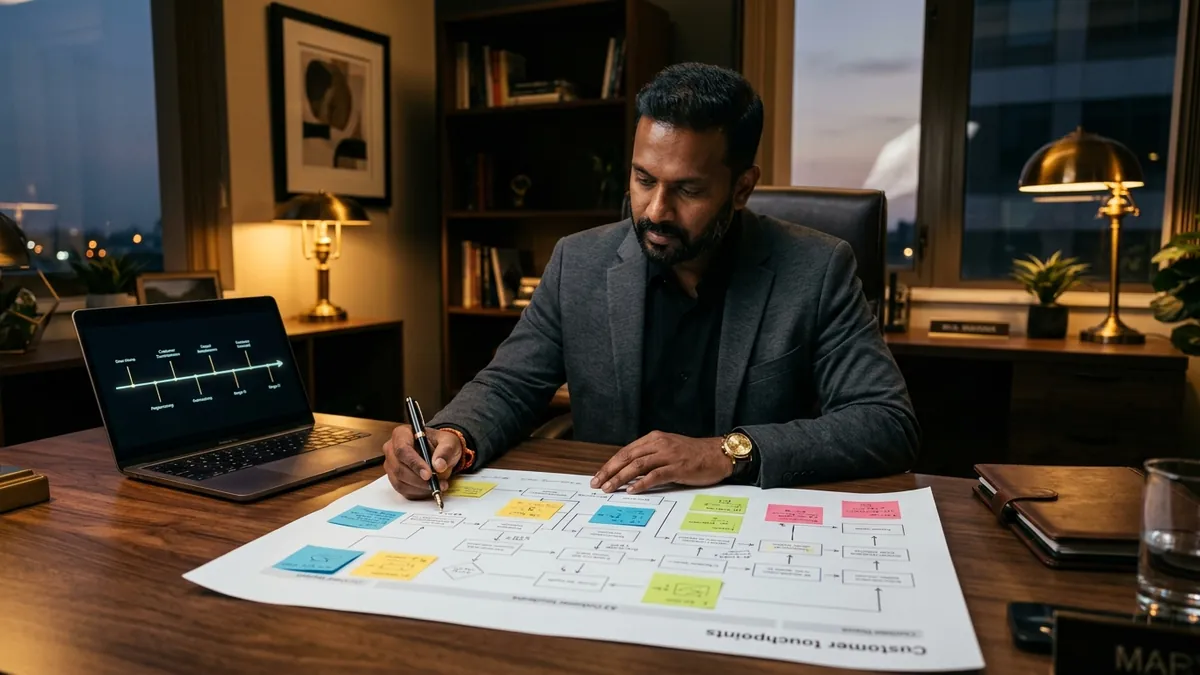
The fix is not complicated. It starts with mapping what actually happens after someone pays you. Write it down on paper. What does the customer experience in the 48 hours after purchase? Do they get any communication from you? Does anyone check in a week later? Is there any reason for them to think about your brand again in the next 30 days? For most businesses I have worked with, the honest answer to all three questions is no. And that absence is the real growth blocker — not the market, not the competition, not the economy.
Once you map it, you will see two or three natural touchpoints where a simple action can make a big difference. A follow-up call or WhatsApp message after delivery. A short check-in three weeks later asking if everything is working well. An early heads-up when something new or relevant is available. None of this requires a CRM tool or a big marketing budget. It requires someone in your team to take ownership and a small system to make sure it actually happens. I have seen a Bengaluru-based industrial supplier add 18 percent repeat revenue in one quarter just by making two follow-up calls per customer that they were not making before.
There is another dimension most founders miss — the gap between what a customer buys and what else they could have bought from you. I call this the invisible menu problem. Your customer bought one product. They may not even know you offer five others that are relevant to them. Not because you hid it, but because you never told them. A proper customer journey includes moments where you naturally introduce other parts of your business. Not pushy upselling. Just relevant conversations at the right time. If you are not sure how to structure this for your specific business, it is worth exploring in a one-to-one consultation where we can look at your actual customer base.
Referrals live in this same territory. Happy customers who hear nothing from you after the sale rarely refer anyone. Not because they are unwilling — but because they forget, or they never get an opportunity. A simple prompt, delivered at the right moment, changes this. After a successful delivery, after a check-in call where they confirm they are happy, that is the moment to say something like — 'If you know anyone who could benefit from this, I would genuinely appreciate an introduction.' Most business owners feel awkward asking. But customers who are satisfied are usually glad to help. They just need a moment to think of it.
One thing I want to be direct about. Fixing your customer journey is not about adding complexity to your business. It is about finishing what you started. You worked hard to win that customer. You delivered the product or service. And then you stopped. Everything after the first sale — the follow-up, the check-in, the re-engagement — is just completing the relationship you already began. When you think of it that way, it feels less like extra work and more like common sense. The businesses I see growing steadily year after year in India are almost always the ones where the founder treats the first sale as the beginning of a relationship, not the end of a transaction.
If you are reading this and recognising your own business in it, start small this week. Pick your last ten customers. Write down the last time you had any contact with them after the sale. If the answer is never, send them a simple message today — not to sell anything, just to check in. See what happens. That small act, repeated consistently, is how you build a customer journey that actually goes somewhere. And if you want a structured way to audit your entire growth process, the 2-day business growth workshop is designed exactly for this — helping you find and fix the specific points where your business is losing momentum.
Want to understand where your business growth is stuck?
Book a Business Growth Diagnostic with Abhijit JK — an honest, focused 60-minute one-to-one session with Abhijit JK on your brand, website and growth.
Book a Business Growth Diagnostic