Why Your Business Runs You Instead of You Running It
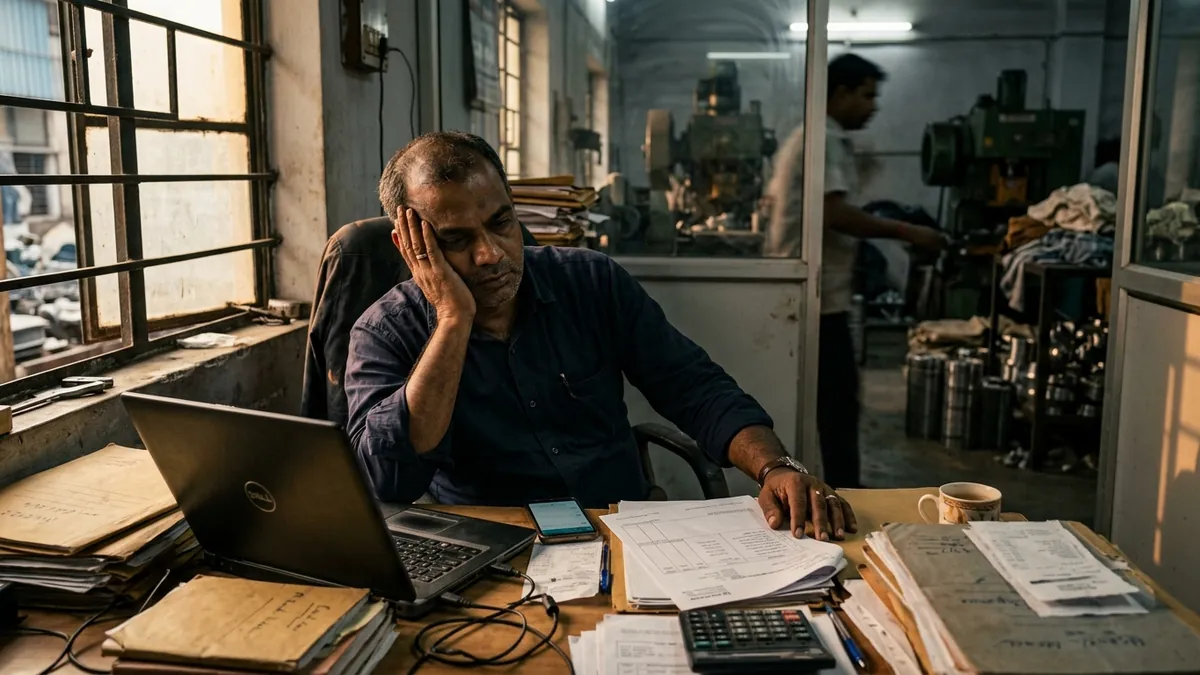
Most business owners I meet in Bengaluru and across India will tell me the same thing when I ask them how they are doing. 'Very busy.' Not 'growing fast' or 'things are going well.' Just — busy. And usually tired. That is a warning sign, not a badge of honour.
When you started your business, you imagined you would be making decisions, meeting clients, building something. What actually happened is you became the salesperson, the operations manager, the accountant, the customer support executive and the social media person — all in one body. Every morning you wake up to a WhatsApp flood. Every evening you are chasing payments or following up on an order that went wrong. There is no off switch.
This is not a time management problem. I have seen this pattern with manufacturers in Peenya, with clinic owners in Jayanagar, with service businesses in Hyderabad and retail store owners in Coimbatore. The root cause is almost always the same: the business was built around the founder's presence, not around systems and roles. Everything needs your approval. Nothing moves without your call. That is not a business. That is a job you created for yourself — with no salary, no fixed hours and no leave.
The danger is not just personal exhaustion. When a business depends entirely on one person, it cannot grow beyond that person's bandwidth. You cannot take on bigger clients because you cannot deliver at scale. You cannot hire confidently because you have not documented how things should be done. You cannot take a two-week holiday because everything will fall apart. I have done a business growth diagnostic with founders who realised their revenue had flatlined for three years — not because the market was bad, but because they were the bottleneck.
Here is the first thing you need to do. Write down every single task you did last week. Every call, every approval, every review, every reply. Be honest. Then mark each one: could this have been done by someone else with the right instructions? Most founders are shocked to find that 60 to 70 percent of what they do every day does not actually need them. It just needs a trained person and a clear process. The reason those tasks land on your plate is not because you are indispensable. It is because you never built the process to hand them over.
The second step is to stop treating documentation as corporate nonsense. I know, it sounds boring. But a one-page process for how your team should handle a client complaint, or how a new order gets processed, or how invoices are raised — that one page is what lets you step back. It is what allows someone else to do the job without calling you fifteen times. Businesses that scale are not run by smarter founders. They are run by founders who built smarter systems. If you want to think clearly about where your business actually stands, a proper brand analysis can show you what is working, what is leaking and where you are personally holding things back.
The third thing is hiring with intention, not desperation. Most MSMEs hire when they are already drowning. They bring someone in, give them no training, no clear role and no way to measure success — and then wonder why it did not work. Hiring only works when you have something to hand over. That means you need a job description that is based on real tasks, not vague expectations. It means you need to spend two weeks showing the new person exactly how things are done. It feels slow in the beginning. It saves you hundreds of hours later.
I also want to be direct about something. Some founders resist letting go not because they lack systems, but because they do not fully trust anyone else with their business. That is an emotional pattern, not a practical one. And I understand it — this is your livelihood, your reputation. But holding on too tight is what keeps a business small. If you have been going in circles on this and need someone to think it through with, a one-to-one consultation is the most direct way to get a clear plan specific to your business and your situation.
The goal is simple. You should be able to take a full week off and come back to a business that ran without you. Not perfectly, but functionally. That is the minimum bar. If that feels impossible right now, it is not because your business is too complex. It is because you have not yet built the people, processes and trust that make it possible. Start this month with that task list exercise. It takes one hour and it will show you exactly where to begin.
Want to understand where your business growth is stuck?
Book a Business Growth Diagnostic with Abhijit JK — an honest, focused 60-minute one-to-one session with Abhijit JK on your brand, website and growth.
Book a Business Growth Diagnostic