Why Your Product Photos Undermine a Premium Brand
Most business owners I meet spend months perfecting their product. They obsess over quality, packaging, pricing. Then they photograph it on a white bedsheet, next to a tube light, with a hand visible in one corner — and upload it directly to their website and catalogue. That one decision quietly destroys everything else they built.
Here is what buyers actually do. They land on your product page or your Instagram profile. They see the photo first. Within about three seconds, they have already decided whether your price feels believable. If the image looks rushed or amateur, a ₹2,000 product feels like it should cost ₹400. No amount of good copy or customer reviews fixes that first impression. The visual does the convincing before words even get a chance.
I have seen this specifically with manufacturers in Bengaluru, Surat, Coimbatore and Rajkot who make genuinely superior products — better material, better finish, better durability than imported alternatives — but lose B2B inquiries to competitors with inferior products and better photos. The buyer cannot touch or test your product online. The photograph is the product, at least at first.
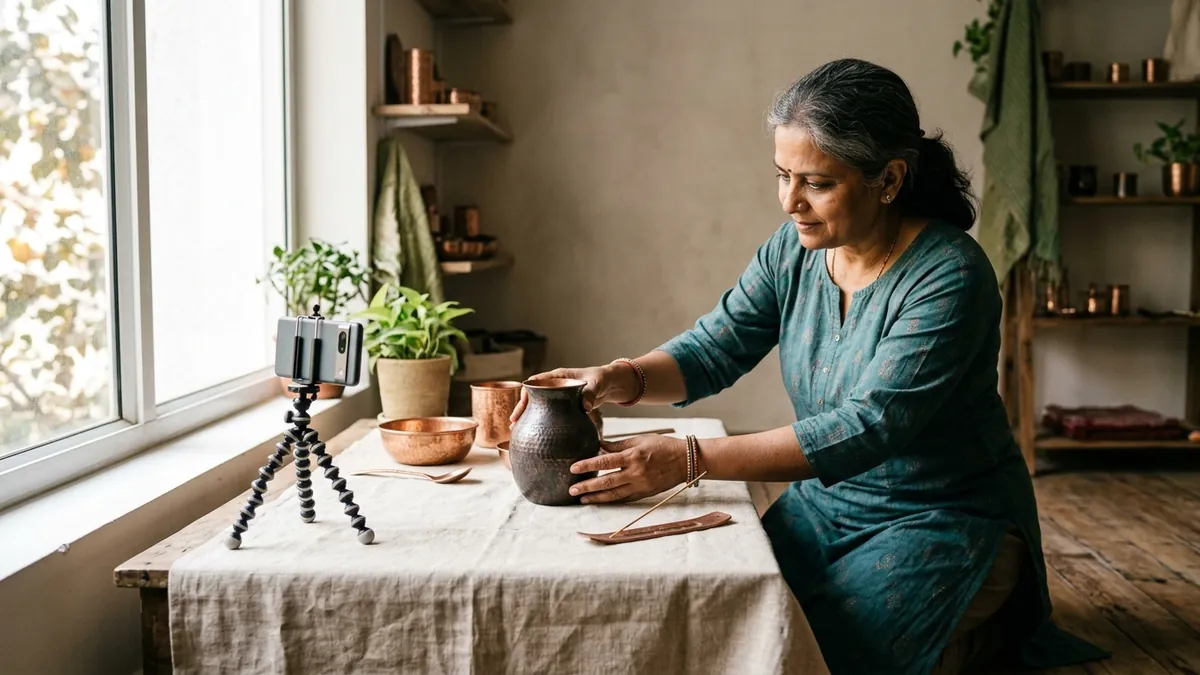
The problem is usually not budget. It is understanding. Most founders think product photography means a professional camera. It does not. It means intentional lighting, a clean background that matches the brand's colour tone, a consistent frame and crop across all images, and a setting that communicates the product's world. A handmade copper bottle photographed against a pale linen background with natural light tells a completely different story than the same bottle against a grey wall under a tube light. Same product. Wildly different perception.
There are a few specific things that kill product photos in India. First is mixed backgrounds — five products, five different backgrounds, making the catalogue look like a flea market. Second is unnatural lighting that creates harsh shadows or washes out the product's actual colour. Third is wrong scale — no reference object, so the buyer cannot tell if the product is the size of a palm or a table. Fourth is no lifestyle context. A plain product shot tells you what the item looks like. A lifestyle shot tells you how it fits into someone's life. Premium brands use both. Most Indian MSMEs use neither.
The fix is simpler than founders expect. Start with one consistent setup. Pick a background colour that is part of your brand's visual identity — neutral tones like warm white, muted beige or slate grey work for most product categories. Use diffused natural light from a window or a ₹1,500 softbox. Shoot every product at the same angle and the same distance. Crop to a consistent ratio — square for Instagram, slightly wider for website. That consistency alone will make your catalogue look like it comes from a serious brand.
For founders who sell physical products — food, apparel, home goods, industrial components, gifts — I always recommend treating photography as a brand decision, not a sales task. The photo should communicate your positioning before the buyer reads a single word. If you are positioned as a premium artisan brand, your photo should feel warm, handcrafted, unhurried. If you are a B2B manufacturer competing on precision and reliability, your product photo should be clean, sharp and well-lit against a neutral background with technical dimensions visible. Different buyers, different signals. This is something I discuss in detail during one-to-one consultation sessions with product brands trying to move upmarket.
One thing founders often overlook is consistency across platforms. Your website might have decent photos, but your WhatsApp catalogue has blurry thumbnails. Your Instagram has good reels but the actual product grid looks inconsistent. Your trade fair brochure uses a different set of images entirely. Buyers who research you across multiple touchpoints — and serious buyers do — pick up on that inconsistency immediately. It signals that the brand is not fully thought through. That makes them cautious about placing a large order or paying a premium price.
If you are not ready to hire a photographer yet, start this week with your phone, one window, one plain background and a simple rule: every product gets three shots — front, detail close-up and one in context. That small discipline will lift your visual quality faster than any design software or new logo. And if you want to understand how photography fits into your broader brand positioning strategy, our business growth workshops cover visual identity and buyer perception in a very practical format built for Indian founders.
Want to understand where your business growth is stuck?
Book a Business Growth Diagnostic with Abhijit JK — an honest, focused 60-minute one-to-one session with Abhijit JK on your brand, website and growth.
Book a Business Growth Diagnostic

