Why Your Website Copy Talks About You, Not the Buyer
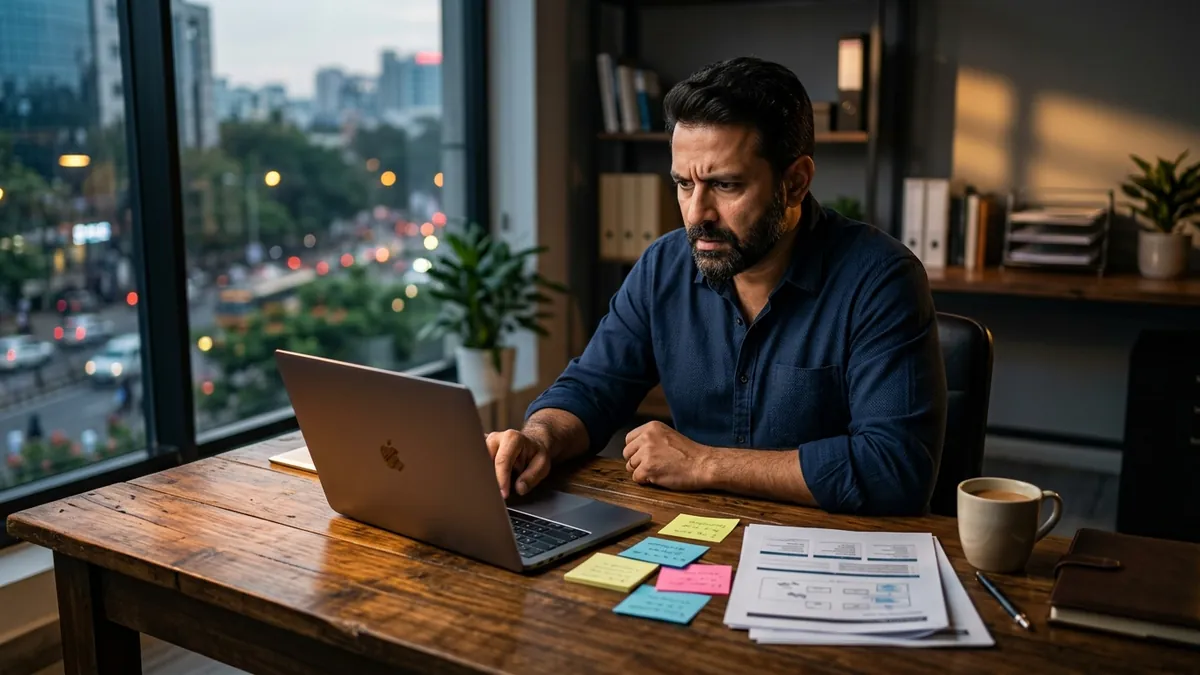
Open your website homepage right now. Read the first three lines. Count how many times you see the words 'we', 'our', 'us'. If you see more than two, you already know why your enquiry form stays quiet. Most business websites in India are written like a company brochure from 2005. They talk about the founder's journey, the year of establishment, the number of clients served, the vision and mission. The buyer is nowhere in that story.
Most business owners I meet believe a website is a place to explain who they are. That is understandable. You worked hard to build the business. You want people to know. But a buyer who lands on your website is not thinking about you. They are thinking about themselves. They have a problem, a deadline, a worry, or a budget. They are scanning your page in under eight seconds asking one silent question — can this business solve my problem? If your copy does not answer that immediately, they are gone.
I have seen this with manufacturers, service businesses, and even well-funded startups. A packaging manufacturer in Bengaluru had a homepage that opened with 'Established in 1998, we are a leading provider of innovative packaging solutions.' That sentence tells a buyer nothing useful. Change it to 'Custom packaging for FMCG brands that ships within 7 days' and suddenly the right buyer knows they are in the right place. Same business, same product — completely different first impression.
The fix is not about fancy copywriting. It is about shifting the subject of every sentence from you to your buyer. Instead of 'We offer end-to-end digital marketing services', write 'You get more enquiries from Google without managing ten vendors.' Instead of 'Our team has 15 years of experience', write 'You work with people who have already solved this exact problem for businesses like yours.' The information is nearly the same. But the second version speaks directly to the person reading it, and that changes everything.
There is a simple test I use when doing a website audit for any business. I call it the 'So What' test. Read each line of your homepage and ask, so what does this mean for my buyer? If you cannot answer that in one sentence, the line needs to be rewritten or removed. Most homepages fail this test in the first paragraph itself. Your about page can talk about your story. Your homepage has to earn the buyer's trust in seconds, and the only way to do that is to talk about their world, not yours. If you want a structured audit of how your website is currently communicating, a one-to-one consultation is a good place to start.
Another mistake I see constantly is burying the specific offering. A business that does interior fit-outs for retail stores will have a homepage that says 'We provide comprehensive interior design and execution services for commercial and residential spaces.' That is too broad. A retail brand looking for a store fit-out partner does not feel spoken to. Narrow your message ruthlessly. Speak to one type of buyer, one type of problem, one type of outcome. You can have separate pages for other segments. But your homepage needs to make one kind of buyer feel like you built the entire business for them.
The structure of your homepage matters as much as the words. The first thing a visitor sees — what designers call above the fold — should answer three questions: what you do, who you do it for, and what the buyer should do next. After that, you can show proof through testimonials, case studies or client logos. Then you can tell your story briefly. Most websites in India do this in reverse order. They open with the story, bury the offer in the middle, and forget to tell the visitor what to do next. If you want to understand how to structure all of this correctly for your specific business type, I regularly cover this in business growth workshops designed for Indian founders.
One thing that often surprises founders — fixing your website copy also improves your Google rankings. Search engines read your content the same way a buyer does. When your copy clearly mentions who you serve and what problem you solve, Google understands your page better and shows it to more relevant searches. This means better website copy is not just a conversion fix. It is also a local SEO move. Two problems solved with one rewrite.
You do not need a new website. You do not need to hire an agency for six months. Start with your homepage headline and the paragraph below it. Apply the 'So What' test. Shift the subject from you to your buyer. Make the specific offer visible in the first scroll. Add one clear next step — a call button, a WhatsApp link, or a short enquiry form. Do this one page at a time and you will see a difference in your enquiries within thirty days. If you want help figuring out exactly where your current website is losing buyers, you can contact me directly and we can look at it together.
Want to understand where your business growth is stuck?
Book a Business Growth Diagnostic with Abhijit JK — an honest, focused 60-minute one-to-one session with Abhijit JK on your brand, website and growth.
Book a Business Growth Diagnostic

