Why Your Exhibition Stall Gets Footfall But No Orders
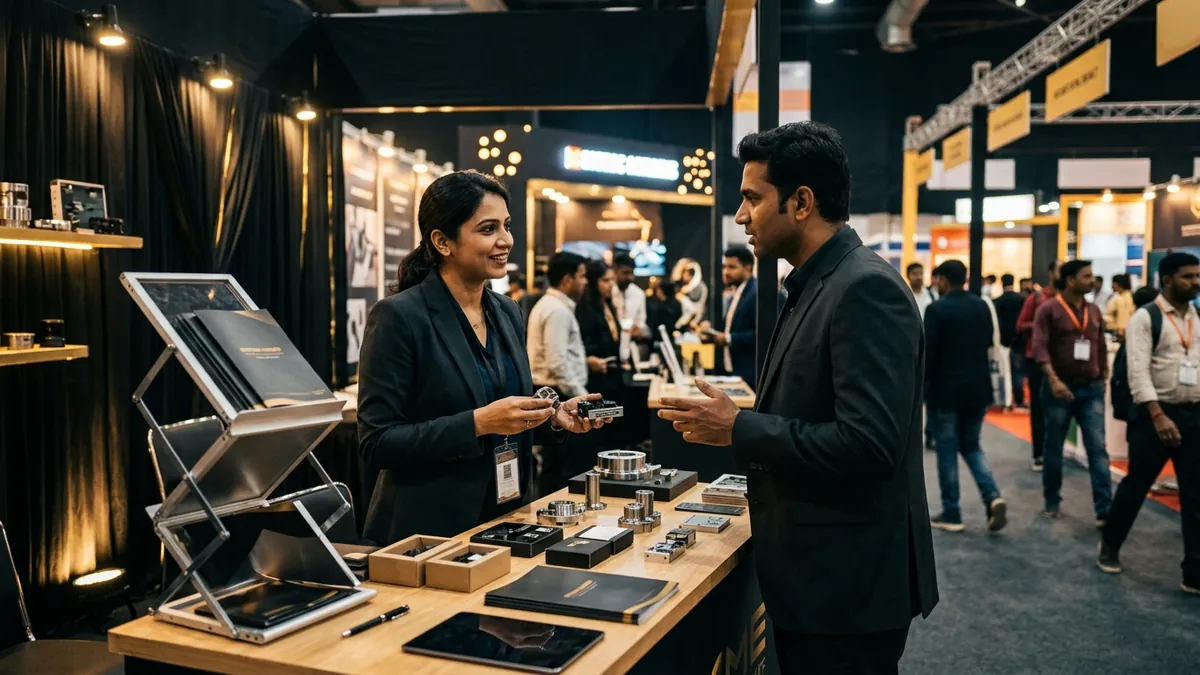
Most business owners I meet have attended at least one trade fair or industry exhibition. Some go every year — ACETECH, IMTEX, India International Trade Fair, regional expos, buyer-seller meets. They spend anywhere from fifty thousand to five lakhs on the stall, travel, standees, brochures and staff. And they come back with two hundred visiting cards, a few WhatsApp numbers, and almost no confirmed business. The footfall was decent. The conversations felt promising. But nothing converted. If this sounds familiar, keep reading.
The first problem I notice is that most stalls are built to look good, not to do a job. The standees are tall, the backdrop is glossy, the products are arranged neatly. But if I walk past your stall as a buyer and spend ten seconds looking at it, I cannot tell who you are for, what problem you solve, or why I should stop walking. A stall without a clear message is just decoration. Your stall needs one sentence that a stranger can read and immediately understand — not your company name, not a tagline about quality or innovation, but a specific statement about what you do and who you do it for.
The second issue is with the people manning the stall. I have seen this with manufacturers especially. The owner is there on day one, enthusiastic and informed. By day two, he has handed it over to a junior sales executive or a field boy who knows the product names but cannot hold a buyer conversation. When a serious buyer walks in with a real question — about MOQ, customisation, lead time, pricing — the person at the stall fumbles. The buyer moves on. You never even know you lost them. Before your next exhibition, spend two hours briefing whoever is standing at your stall on the five most common buyer questions and the exact answers to give.
Third — and this is where most MSME owners lose the game — there is no follow-up system. You collected two hundred cards. You came home tired. You told yourself you would call everyone next week. By next week, you called fifteen. By the week after, you called five more. The remaining hundred and eighty people either forgot you or found someone else. The exhibition circuit is brutal because every competitor is doing the same post-show follow-up delay. The business goes to whoever follows up first and most clearly. I recommend a simple rule: every lead gets a WhatsApp message within twenty-four hours of the conversation, not a generic one, but one that references what you discussed at the stall.
Another reason stalls fail to convert is that there is nothing to take away except a brochure. Brochures are fine, but buyers collect fifteen of them and bin most. What actually works is something specific — a one-page sheet that answers the exact question a buyer in your category is asking. If you make industrial components, that sheet should show tolerance specs, material options and a sample lead time. If you run a clinic or diagnostic centre at a health expo, that sheet should show your most-requested packages with clear pricing. Give them something they will refer back to when they are sitting at their desk making a vendor decision.
I also want to talk about stall conversations themselves. Most business owners spend exhibition conversations talking about their business. How long they have been around, how many clients they have, what their factory capacity is. The buyer is not asking any of this yet. They are standing at your stall for forty-five seconds deciding whether to give you five minutes. The only way to earn those five minutes is to ask them a question about their situation first. What are they sourcing? What problem are they trying to solve? What is frustrating them about their current supplier? Once you know that, you can speak directly to it. This is a skill, and it can be practised. If your team needs help with this kind of communication, a one-to-one consultation before your next trade fair can make a measurable difference.
Pricing is another silent killer at exhibitions. Many MSME owners are reluctant to talk numbers at the stall. They say things like 'we will send you a quote' or 'it depends on the quantity.' Buyers hear this as either evasiveness or unpreparedness. You do not need to give a final price at the stall, but you need to give a range or a starting point. 'Our pricing starts at X for a basic order of Y units' is enough to qualify whether the buyer is serious or not. It also shows confidence. Buyers trust suppliers who know their own numbers.
One thing that rarely gets discussed is stall positioning within the exhibition hall. If you are a small MSME with a limited budget, you often end up in a corner or at the far end of the hall where footfall is naturally lower. This is a logistics reality, not a brand failure. But you can compensate for it. Dress your team in a consistent, recognisable colour. Create a reason for people to come to your stall — a live demo, a sample giveaway, a short three-minute product explanation that runs on a screen. Give people a reason to walk the extra distance. I have seen businesses at business growth workshops share simple ideas like this that tripled their stall conversations without spending more on the booth.
Exhibitions are not a waste of money. They are one of the best places to meet serious B2B buyers, distributors and decision-makers in one room. But they only work if your stall communicates clearly, your team is prepared, your follow-up is fast and your conversion process does not end when the event does. The businesses that consistently win orders at trade fairs are not necessarily the ones with the biggest stalls. They are the ones who treat the exhibition as the beginning of a sales conversation, not the end of a marketing effort. Fix these gaps before your next show, and the same footfall will start giving you very different results.
Want to understand where your business growth is stuck?
Book a Business Growth Diagnostic with Abhijit JK — an honest, focused 60-minute one-to-one session with Abhijit JK on your brand, website and growth.
Book a Business Growth Diagnostic

