Why Your Exhibition Stall Gets Visitors But No Orders
Most business owners I meet who participate in trade fairs tell me the same thing. 'We had good footfall. People stopped, took our brochure, seemed interested — but nothing came of it.' They say this about Garment fairs, Engineering Expos, Food & Beverage trade shows, Pharma conventions. It doesn't matter the industry. The problem is almost always the same set of mistakes, repeated at every booth, every year.
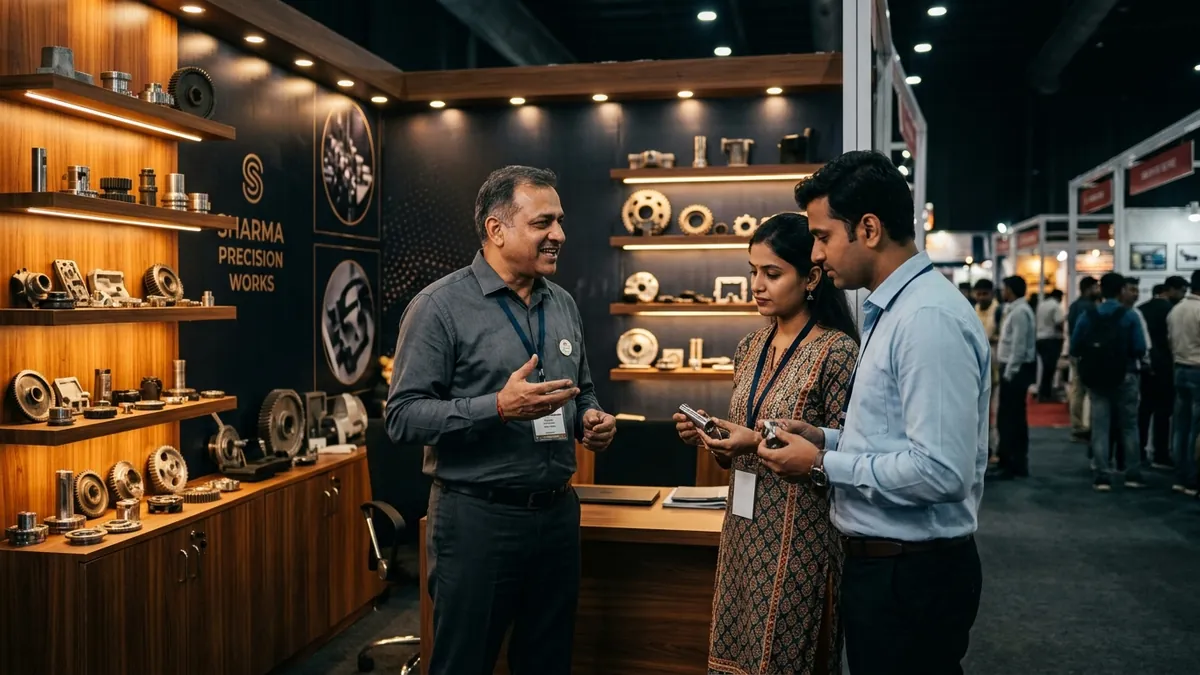
The first thing a visitor decides — in under eight seconds — is whether your stall is worth stopping at. This is not about having the biggest stall or the fanciest lights. I have seen a 9x9 stall with clean branding, one strong headline and a focused product display outperform a 30x30 island stall that looked like a cluttered warehouse showroom. When you try to show everything, the visitor registers nothing. Your stall needs one clear visual anchor. One reason to stop. Most stalls fail here before a single word is spoken.
Then comes the conversation problem. Trade fairs attract two kinds of people walking past your stall — genuine buyers and browsers. Most stall staff cannot tell the difference, so they treat everyone the same way. They launch into a product monologue the moment someone picks up a sample. A serious buyer does not want a recital of specifications. They want to know if you understand their problem. The single best question your team can ask anyone who stops is: 'What are you specifically looking for today?' That one question separates the real enquiries from the casual visitors and changes the entire direction of the conversation.
Here is something I see constantly with manufacturers and product companies. They design the stall for display but build no system for follow-up. Business cards pile up in a box. Enquiry sheets are half-filled. By Day 3 of a 4-day fair, your team is exhausted, the enthusiasm is gone, and serious visitors from Day 1 are already forgotten. Every person who engages with your stall — even briefly — needs to be captured in a simple format: name, company, what they asked about, what you promised to send. A WhatsApp number and a one-line note is enough. Without this, you are spending three to five lakhs on stall participation and doing zero with 80 percent of the opportunity.
Brochures are another silent killer of exhibition ROI. I have seen MSME owners print five thousand copies of a brochure that lists every product they make across sixteen pages. Nobody reads it. Buyers at exhibitions are moving fast, carrying bags that get heavy by noon. They will keep two or three things and throw the rest. Give them one focused leave-behind — a single A4 or a folded card — that shows your top three products or services, a clear differentiator, and your contact. That is it. If they want more, they will ask. If you want to go deeper on how your marketing materials should work together, this is exactly the kind of thing I work through in a one-to-one consultation.
Pricing is another thing founders handle badly at exhibitions. Either they refuse to discuss price at all and say 'send us a requirement, we will quote' — which kills momentum — or they give out prices without understanding what the buyer actually needs, which starts a negotiation they cannot win. The smarter approach is to have a conversation about volume and application first. Once you understand the buyer's context, pricing becomes a part of the solution rather than the first point of friction. Buyers respect sellers who ask good questions before quoting. It signals that you understand the business, not just the product.
I also want to talk about the stall team itself. Many MSME owners send junior staff or factory personnel to man the stall while they circulate or attend sessions. The problem is that serious buyers — purchase managers, procurement heads, retail chain buyers — often ask questions that need a decision-maker present. If your team cannot answer 'Can you do private labelling?' or 'What is your minimum order for a trial?' without saying 'I will check with Sir and call you,' the buyer moves on. Exhibitions are expensive. Send someone with authority, or be there yourself for at least the first two days. If you are building a business where you are the key person in every conversation, that is a different challenge worth addressing — I run business growth workshops where founders work through exactly this kind of bottleneck.
The biggest mistake I see, though, is treating the exhibition as the end point rather than the start of a sales cycle. Founders come back from a fair hoping orders will flow in by themselves. They wait a week. They send a generic 'It was nice meeting you at XYZ Expo' message to fifty contacts. Nothing happens. A trade fair is a lead-generation event, not a closing event. The real work starts on the fourth day after the fair ends. Structured follow-up, personalised messages referencing what the buyer specifically asked about, a clear next step — a sample dispatch, a video call, a site visit. Without this cadence, the fair was an expensive three days of standing on your feet.
If you are planning to participate in any trade fair in the next three months, do this right now. Identify one clear message your stall will communicate. Decide on one strong leave-behind. Train your team on two questions to open every conversation. Build a simple enquiry capture format. And block time in your calendar the week after the fair specifically for follow-up. That alone will put you ahead of 70 percent of the stalls around you. If you want to work through your exhibition strategy or broader sales and brand positioning before your next big show, you are welcome to reach out and we can figure out where to start.
Want to understand where your business growth is stuck?
Book a Business Growth Diagnostic with Abhijit JK — an honest, focused 60-minute one-to-one session with Abhijit JK on your brand, website and growth.
Book a Business Growth Diagnostic